Zygomatic Implants

While investigating dental implants there are various elements to shoulder at the top of the priority list, especially in the event that you’ve encountered bone misfortune. Why? Since paying little mind to method, dental implants require solid bone. This isn’t an issue if a patient is in great oral wellbeing and has adequate issue that remains to be worked out implants ; nonetheless, those with extreme bone misfortune in the upper jaw may require a propelled choice – Zygomatic implant treatment .

What are Zygoma implants and how are they different?

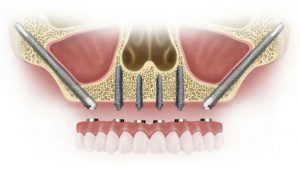
traditional dental implants involve drilling directly into the upper jaw bone, which often requires a bone grafting procedure to ensure proper implant placement. Unfortunately, for those with severe bone loss in the upper jaw, such bone grafting techniques may not be suitable. Zygomatic implants, however, offer an alternative. Instead of using the upper jaw bone as an implant anchor, Zygomatic implants take advantage of the neighboring healthy cheek bone (i.e., zygomatic bone). Longer in size than conventional dental implants, Zygomatic implants are designed to provide a secure foundation in situations where traditional dental implants may not be possible.

What are the benefits of using Zygoma implants?

Beyond giving patients with severe bone loss a viable implant option, Best Zygomatic implant treatment in Chennai have a number of advantages over traditional dental implants. These include:

Immediate function – Zygomatic implants are a “graft-less” procedure which expedites the entire experience allowing patients to leave with immediate aesthetic and functional improvements. When bone grafting is needed, patients may be required to wait up to 12 months for complete healing to occur before restorations can be placed. This is not necessary with Zygomatic implants, as temporary restorations and zygoma bone implants can be put in place during the same appointment.

Faster recovery – Because the overall process is shorter, patients require fewer visits than are necessary with traditional implant treatments. In addition, they are able to return to work and resume normal routines faster because healing time is significantly shorter.

Improved bone strength – Zygomatic dental implants are made of titanium which stimulates the surrounding bone to develop new bone structure via a process known as osseointegration. Not only does this help to secure the implant, it also strengthens the surrounding bone.

Minimally invasive – Unlike traditional implant techniques that require invasive bone grafting, Zygomatic implants use 3D scanning for accuracy and are generally performed under IV sedation.

Am I a candidate for Zygomatic implants?

Best Zygomatic implant treatment in India may be an option if you’ve previously been told you don’t have enough bone for traditional dental implants. Though the thought of anchoring implants to your cheek bones may be off-putting, the use of Zygomatic implants reduces overall treatment time and is much less invasive than other dental treatments, making it a great option for those with severe upper jaw bone loss.
When orthodontic treatment might be needed

Crooked, crowded and overlapping teeth can cause a range of problems, including: 

  • tooth decay and gum disease – teeth that are very close together can be harder to clean properly. A build-up of plaque can lead to tooth decay and gum disease
  • injury to the gum – if a tooth doesn’t meet with its partner on the opposite jaw properly, it may dig into the gum and cause damage
  • wear and tear – if teeth don’t sit properly the action of chewing can wear them unevenly
  • self-confidence – teeth problems can make people feel embarrassed and they may not feel comfortable to smile.

Diagnosis of teeth and jaw alignment problems

Problems with teeth and jaw alignment are identified using a number of tests, such as: 

  • x-rays of the mouth
  • impressions of the upper and lower jaws, which are used to make plaster casts.

Examples of orthodontic problems

Some common orthodontic problems are: 

  • excessive overbite – when the top teeth bite over the bottom teeth more than usual. With teeth closed, you would usually expect to see about half of the lower teeth. If you see less than half, this could be an excessive overbite
  • underbite – when the bottom jaw sits further forward than normal. When teeth are closed, the lower front teeth sit in front of the upper front teeth
  • protruded teeth – when the upper jaw sits further forward than the lower jaw. With the teeth together, you would expect the upper teeth to sit on the inside of the lower lip. If they sit over the lower lip, this might be a sign of protruded teeth. A person with protruded teeth is more at risk of tooth damage or loss from accidents and may have speech or eating problems. Many people also choose to correct protruded teeth for cosmetic reasons
  • crowded teeth – when there is not enough space for teeth to sit side by side and they overlap. Can be caused by large teeth, a small jaw, or both.

Examples of orthodontic treatments

A range of orthodontic devices may be used to move teeth, or to keep them in place. These include: 

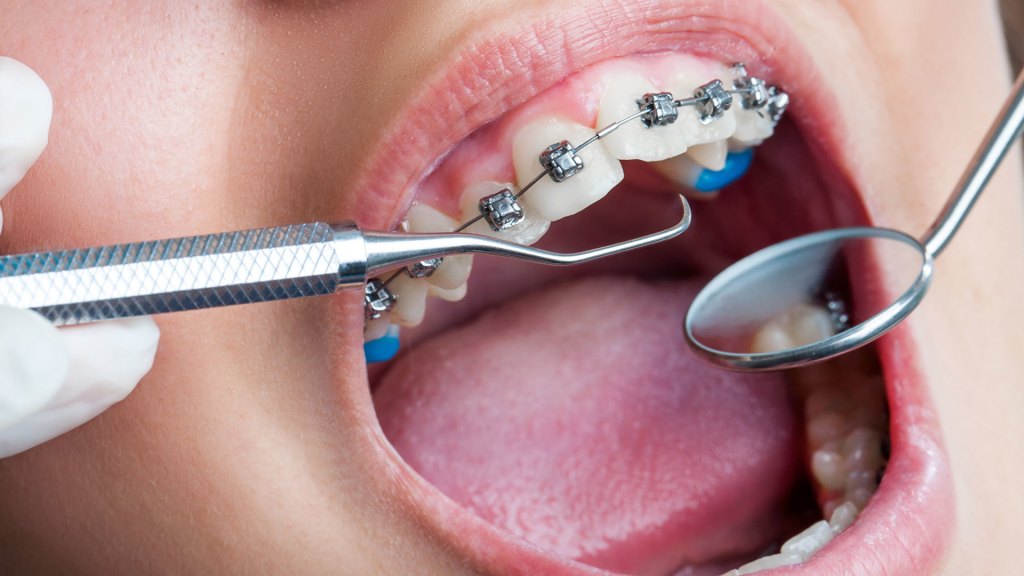
  • braces – tiny brackets are attached to the front or back of each tooth, and a wire is tied to them. The constant gentle pressure of the wire slowly moves the teeth
  • clear aligners – also known as ‘invisible braces’, clear aligners are clear pieces of custom-moulded plastic that sit over the teeth and gradually move them. While you usually need to wear clear aligners for 20–22 hours a day, you are able to take them out to eat, drink and clean them
  • elastics – these small rubber bands are stretched between upper and lower braces for extra force to move teeth
  • plate – a plastic device that sits in the mouth and uses wires and springs to push teeth into a particular position, or to hold them in place. Unlike braces, a plate can be taken out of the mouth.

Age for orthodontic treatment

Usually, teeth problems that may benefit from orthodontic treatment can be detected by between seven  and nine  years of age. Most orthodontic treatment is done after all the permanent teeth have come through, at around 11 to 13 years. Some treatment can be started earlier, at about age eight or nine. Adults can be treated too.

Risks of orthodontic treatment

Some of the risks of orthodontic treatment include: 

  • dental hygiene problems – braces and wires make cleaning the teeth more difficult. This may increase the chance of tooth decay and permanent marks. It is important that teeth are cleaned thoroughly twice a day during orthodontic treatment to avoid these problems
  • soft tissue injury – braces may dig into the gums or cheeks, damaging them
  • relapse – the corrected teeth may move again once braces are taken off. The main reason plates or retainers are worn after braces have been taken off is to prevent this from happening.

Who provides orthodontic treatment?

Orthodontic treatment is provided by an orthodontist, and sometimes by a dentist. An orthodontist is a dentist who has done additional study to specialise in the diagnosis, prevention and Veneers dental treatment of problems in the alignment of teeth and jaws. 

The orthodontist or dentist will take detailed records of your teeth and jaw, diagnose any problem, plan the treatment and carry out the care as required.

Costs vary depending on the type of problem and the amount of treatment needed. Ask your orthodontist or other oral health professional for advice.

Teeth care during orthodontic treatment

Talk to your orthodontist or oral health professional about how to care for your teeth during treatment. 

For example, if you’ve got braces, it’s even more important to floss regularly, as the brackets and wires can capture more food particles and plaque. If using string or tape is too tricky, there are other methods to help keep the teeth and gums clean, such as floss threaders for braces or interdental toothbrushes. 

Interdental toothbrushes are small brushes that have been designed to get into small spaces including around brackets and the gaps between teeth. They can be particularly helpful when undergoing braces treatment.

Where to get help

When is cosmetic dentistry needed?

Cosmetic dentistry can help you improve your smile by making

•  When your teeth are discolored or stained, we can make your teeth whiter.

•  Reshaping your teeth, that is awkwardly shaped and does not match other teeth,

•  To close abnormal spacing between teeth.

•  Filling dental cavities with tooth-colored restorative materials.

•  Fixing uneven surfaces with fillings that shade match with your teeth and covering fractured teeth with porcelain crowns.

So, what do we do in cosmetic dentistry?

Cosmetic dentistry encompasses various dental treatments targeted at improving the appearance of the teeth – whitening, bonding, veneers, reshaping, orthodontics and dental implants.

Inlays and Onlays

Also known as indirect fillings, inlays and onlays are dental restorations which are fabricated in a dental laboratory. They are mainly used when a tooth has minor to reasonable decay, or there is not sufficient tooth structure to retain a direct dental filling. If the cusp (an elevation seen on the chewing surface of the tooth) is not damaged, then an inlay can be directly placed onto the tooth surface. When the cusp or a more substantial portion of the tooth is destroyed, however, an onlay can be used instead.

Inlays and Onlays are fabricated in a dental laboratory using materials such as a composite resin (a tooth-colored material) or even ceramics and attached to the teeth with adhesive dental cement. They provide adequate strength to the teeth, help in reestablishing the shape and will prevent further decay.

Composite Restoration

Composite restoration refers to the repair/filling of decayed, damaged or discolored teeth using material that resembles the color of tooth enamel. The composite material successfully covers the damaged portion of the tooth and can provide a healthy teeth appearance. Direct tooth-colored composite restoration is one of the least expensive cosmetic methods available to patients with tooth decay, cracked teeth or fractures teeth.

Dental Veneers

Dental veneers are ceramic made partial crown-like structures. They are customized for each patient and are prepared to resemble natural teeth. They look remarkably natural and can treat various cosmetic problems, starting from crooked teeth, to damaged enamel to minimal gaps between two teeth. The dentist places the veneer on the front surface of each tooth using a dental adhesive.

Teeth Whitening

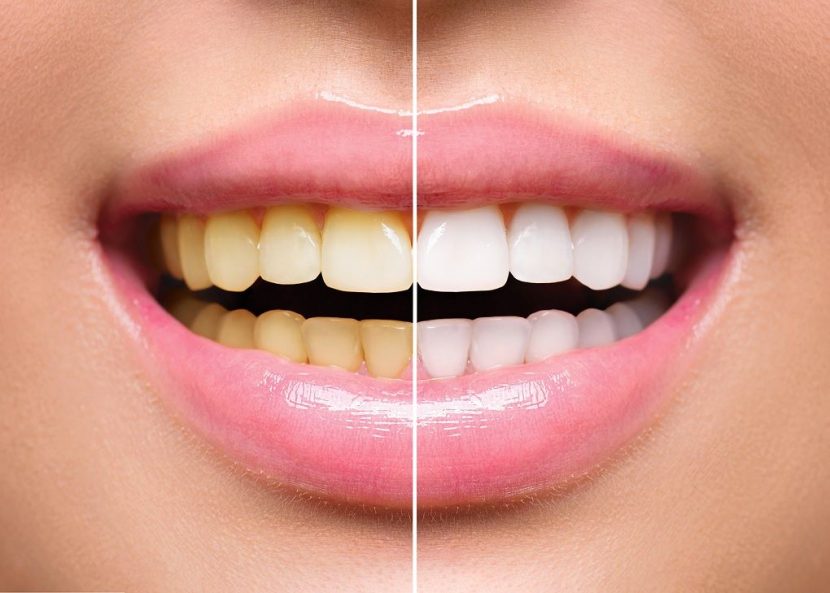
Teeth Whitening or teeth bleaching is one of the most commonly performed cosmetic dental procedure. Teeth can get discolored by excessive smoking, drinks or even due to a specific medication. This bleaching can be performed in the dental office or even at home. After a thorough cleaning of all the teeth in the oral cavity, teeth whitening procedure is carried out to give it a natural appearance. A shade even lighter than the natural color of your teeth can achieve with bleaching.

For a detailed reading on teeth whitening, visit our page

https://www.rajandental.com/teeth-whitening-treatment/

 Implants

Dental implants are prosthesis used to replace missing teeth. The dentist places a titanium screw in the jaw bone at the spot of the missing tooth, which supports the crown. These implants are near identical to the natural teeth, and once the bone fuses to the titanium screw, they are permanently secured into place. Patients need to maintain excellent oral hygiene after the implant placement to prevent food and debris from lodging in the area.

To know more about implants, visit our page

https://www.rajandental.com/zygoma-implant/

Orthodontics

An even essential component of aesthetic smile design is alignment correction of teeth. Spacing, crowding, rotations, proclination etc., can be treated efficiently using orthodontic appliances like braces, headgears, etc.

Rajan Dental Hospital can provide you with a refreshing, natural-looking smile that will make you look great and feel better about yourself. Visit us and let us help you discover the Cosmetic Dentistry in Chennai option that’s perfect for you.

What causes discoloration of teeth?

Discoloration of teeth can occur due to several reasons. The most common reasons causing discoloration are:

  • Ageing
  • Wear of teeth due to grinding
  • Poor oral hygiene
  • Ingestion of coloured foods and drinks such as coffee, tea, colas, red wine etc.
  • Tobacco use
  • Tetracycline medication
  • Consumption of certain antibiotics
  • Excessive fluoride ingestion

How is teeth whitening performed?

Procedure

Your gums are carefully protected with a special covering. The whitening solution is applied to the teeth and activated with a special light in the dental clinic. Alternatively, a whitening gel is provided to you to be used with a custom-made tray at home.

Is whitening safe?

Yes. Many clinical studies and extensive research have proved that under the supervision of a dentist, teeth whitening is safe. Many dentists consider teeth whitening to be one of the safest cosmetic dental procedure available. The whitening agent helps remove internal stains in your teeth and restore the color back to their original shade. So if you have noticed your teeth discolour over time, you are likely to have great results after whitening them.

Teeth whitening Treatment is not recommended for children under 13 years and pregnant or lactating women.

For how long do the results stay?

Certain simple post whitening care instructions need to be followed which will be explained to you by our team of dentists. We recommend avoiding coloured liquids and tobacco for a few days after whitening for about a week after the procedure, to maximize the effect of the teeth whitening.  Alternatively, coloured liquids can be swallowed with a straw so that it does not contact the front surface of the teeth. We also recommend flossing and brushing twice daily to keep your teeth in a good and healthy condition. Depending on your lifestyle, you may need to whiten your teeth periodically.

Does teeth whitening have any side effects?

Post treatment sensitivity may occur with some patients. Generally, this sensitivity disappears in 2-3 days. The Teeth Whitening In Chennai contains a gel which can be used to reduce the sensitivity. In case sensitivity persists, a desensitising toothpaste can also be prescribed which helps reduce the sensitivity.

Are there different types of whitening available?

Whitening teeth can be done with a simple tray that can be used to hold the whitening agent while you sleep. This tray fits in close contact with your teeth, and the whitening process occurs over night. A more effective way with better results is to do a chair side whitening, where the whitening agent is applied to your teeth and a high intensity blue light is then used to activate the agent. Chairside whitening usually requires four cycles, with each cycle lasting for 15 minutes. At the end of every cycle, the whitening agent is cleaned and re-applied, and the light is again shown for 15 minutes. Completion of all four cycles is not mandatory, and the procedure can be stopped at any time if the colour obtained is satisfactory, which it usually is.

Can whitening be used to whiten veneers or crowns?

No, it cannot. Whitening only works on natural tooth structure and does not work on ceramic.

How much does teeth whitening cost?

The cost of teeth whitening varies depending on the type of technology used. Please contact Rajan Dental at  +91 7338965659 or https://www.rajandental.com/teeth-whitening-treatment/ to schedule a consultation.

How is teeth whitening different from teeth cleaning (scaling)?

Teeth cleaning involved removing macro stains and deposits on the surface of the tooth with an ultrasonic instrument. Teeth whitening removes microscopic stains that are lodged within the pores of the teeth.

I haven’t had my teeth cleaned in a long time. Should I whiten my teeth or clean them?

We always recommend a teeth cleaning prior to a whitening procedure. This is because macroscopic stains on the teeth can block the action of the whitening agent and reduce the effectiveness. After the teeth cleaning procedure, if you are happy with the colour of your teeth, it may not be required to whiten the teeth.

What can I do to have my teeth continue to remain white?

Avoiding excessive consumption of coloured liquids such as tea, coffee and wine can help reduce the amount of discolouration your tooth will undergo. Using a straw is another great way to make sure these coloured liquids do not darken the front of your teeth. Tobacco (cigarettes and chewing tobacco) are notorious for staining and discolouring teeth, and they should be avoided if you intend to keep your teeth staying bright and white.

I need to have a crown on my front tooth, when is the right time to whiten my teeth?

If you are having a crown or veneer done on a front tooth, it is a good idea to make sure that you like the colour of your existing front teeth. The lab technicians at Rajan Dental will match the colour of your new crown to your existing teeth to perfection. If you want to whiten your teeth, it would be best to do this one week prior to your crown measurement appointment. This will allow the Laser Teeth Whitening Cost in Chennai to have a stable colour and will allow the Rajan Dental team to select a shade that will complement your beautiful white smile.

Design a site like this with WordPress.com
Get started